
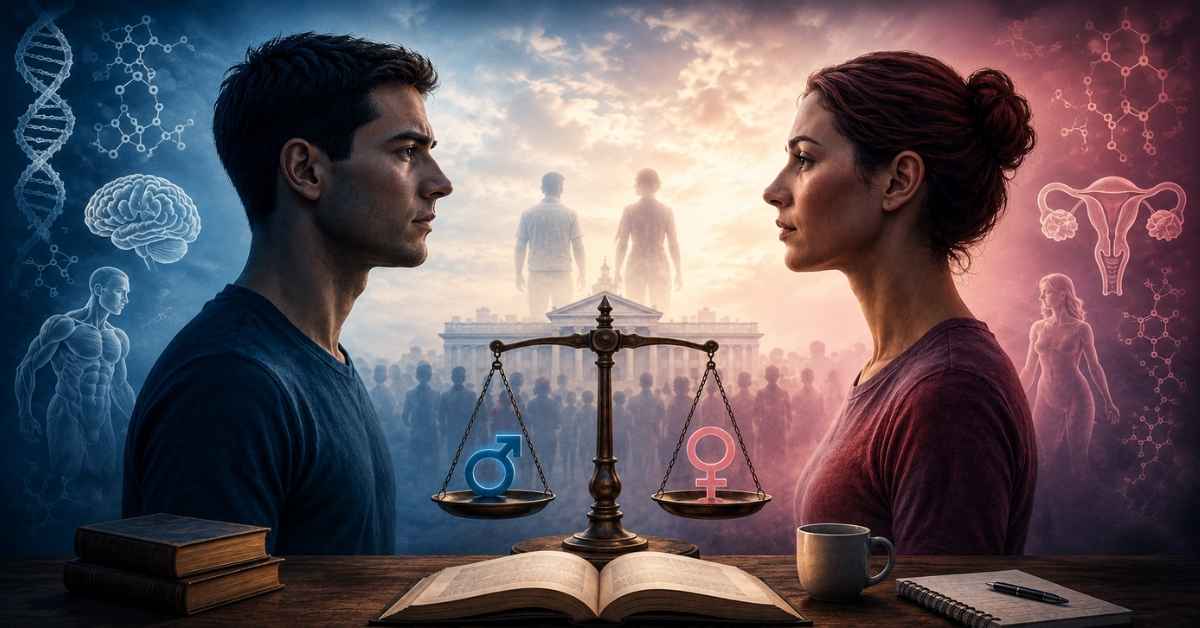
Ask your senators, “Senator, what is a woman?” and watch some of them struggle to answer. Follow up with: “Senator, is there a difference between a man and a woman?” This should be a simple yes-or-no question with an obvious answer. Yet some people insist on adding qualifiers. Here, I respect personal preference towards self-identification, which is one of today’s central issues in politics, as well as social order and structure, but if someone can’t define what a man or woman is, or whether they differ, how can they make far more complex decisions about our lives?
After all, gender identification lies at the heart of modern societal debates, such as:
- Should men compete in women’s sports?
- Should women’s sports exist at all?
- Should men use women’s bathrooms?
- Should bathrooms even be separated by gender?
- Should there be legal and social distinctions between men and women?
My answer to these questions starts at a basic level: At birth, men and women have fundamentally different genitalia. Women are the ones biologically capable of giving birth, while men are not. On average, men are larger, with greater physical strength. Even our skeletal structures are built differently—men generally have denser bones and broader shoulders, while women tend to have wider hips, optimized for childbirth.
Scientifically, women have XX chromosomes, men have XY. This isn’t a matter of opinion or identity, but a matter of genetics, easily verified with a simple mouth swab test. Men and women have distinct hormonal profiles—testosterone in men drives muscle mass, aggression, and risk-taking behaviors, while estrogen in women influences traits like nurturing tendencies and emotional processing. Brain structure differs too: studies show variations in the amygdala, hippocampus, and prefrontal cortex, affecting how men and women process emotions, stress, and decision-making.
When it comes to sports and bathrooms, society typically offers only two options: men and women. Some reject these labels. In such cases, we shouldn’t force them into binary groups. Instead, we should create a third category. If that’s not feasible, they should use facilities matching their biological sex. If this causes conflict, they should make their own arrangements.
While this may raise difficulties for some people—who might have to travel additional distances to address their necessities, causing them discomfort—it’s also true that by challenging the status quo, they are creating additional discomfort for many more people who operate in a traditional way. It’s not that we should try to make everyone feel comfortable—because that’s not possible—but we should let people be mindful of their own needs and if they are different from those of the rest, they should be mindful that they will have to address them themselves.
For example, as a vegetarian, I don’t demand a vegan menu at a steakhouse. I don’t insist on a smoke-free area in a smoking zone. I can’t walk naked in the city center, no matter how much I identify as a nudist.
In politics today, we push for progressive changes—and that’s fine in principle. But we shouldn’t resort to anger or violence when people resist. The status quo exists for a reason, and we can’t expect overnight compliance with new “correct” norms (whatever they may be).
Certainly, I’ll be the first to agree that everything isn’t perfect and everything is working as it should. However, the guideline should be: the greatest happiness for the greatest number, suggesting that the well-being of one individual should not put thousands into discomfort.
Do you agree? Stay happy.










1 thought on “Are Men and Women Different: Gender Identification Debate”
I appreciate your willingness to look into a tense conversation. When you have the time, definitely look into intersex people and the smaller details. While I was dreaming of being a biology major, I had discovered that chromosonal and hormonal differences showed variation in the expression of male and female sex traits. And how that difference appears differently in intersex people. It’s actually really interesting!
Wishing you all the best in your writing journey.