

Part 1: Cinema, Autopilot, & Identity Disconnect
If you’ve ever been to the cinema, you may have experienced a moment of existential disconnect—where you were temporarily detached from your body, your ego, and your everyday problems, completely absorbed by the movie. Then the movie ends, and you’re back to reality, thinking, “Oh, I exist again.” Here, all it took was for two of our five senses—vision and sound—to be engaged, and already we experienced a full sense of disconnect from reality. So what if we could engage even more senses—adding smell, touch, or taste? Arguably, a full sensory experience could make a movie indistinguishable from reality. This idea alone suggests that we might already be living in a kind of Matrix, so fully immersed in our surroundings that we accept them as real.
And this existential disconnect happens all the time. We fly almost on autopilot throughout our lives, punctuated by moments of lucidity where we disconnect from the autopilot we’ve been operating on. In fact, I once heard that human beings spend most of their time on autopilot, with only occasional moments of clarity—moments when we can consciously give our bodies new directions, so to speak, and reprogram that autopilot. In other words, it’s almost as if we’re mere observers of our own autopilot, and the quality of our lives depends on the directions we give ourselves. This once again raises the question: Do we truly exist, or are we just the sum of our programmed responses?
Part 2: Self vs. No-Self
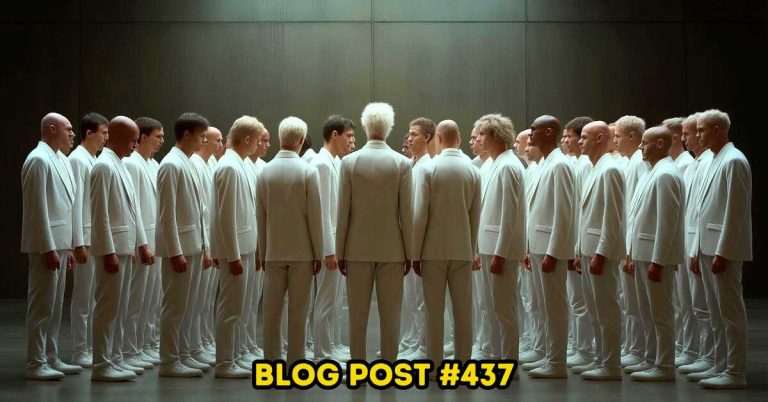
I’m reminded of an old movie called Dark City (1998), where aliens searching for the human soul would reprogram human beings every night. One day a person is a plumber; the next, they are a president. One day they are a woman; the next, a man. Then they are poor; then they are rich; then they believe in democracy; then they believe in communism. In turn, the aliens try to compare the same person with different characteristics, attempting to identify that constant thing that makes us us.
While this movie is thought-provoking and interesting—and some would call it science fiction and leave it at that—others might compare it to how we live our lives today, albeit at a progressively slower rate. After all, what makes me me? If, for example, I change my clothes, undergo plastic surgery, change my opinions, or anything else—did I change? Did my old self die, and am I reborn into a new self? Or does the old me continue to exist, perhaps in some new capacity?
This is relevant because our sense of self is so important to us. In some cases, we can die or hurt others for our opinions and beliefs, building and destroying relationships based on what we think and other things. In turn, we spend a lot of time, money, and energy investing in this something that we can’t even define, and which is constantly changing.
To this point, some philosophers and even religious groups have suggested that because our sense of identity is not so stable, it might not even exist. They call this experience “no-self,” which essentially suggests that whoever you think you are, you are not. In turn, our egos, identities, and everything we hold so dear to ourselves is nothing more than a creation of our complex brains, reinforced by society and marketing, designed to make us behave in a certain way. This makes us look for something that might not even be important to us—or exist.
In turn, disconnecting from a self that never existed in the first place can bring us a lot of peace. Almost like Sisyphus, who is told to push the rock up the hill repeatedly and without end, only to see it roll back down and have to repeat the process again and again the next day. In this way, Albert Camus, who wrote The Myth of Sisyphus, suggests that the only way to become happy is to “imagine Sisyphus happy,” accepting the existential dread metaphorized by endlessly pushing the rock up the mountain as something we like and enjoy, because it is life. Liberating ourselves in this way, we therefore become happy.
After all, when we say that we want something and we don’t have it, that is when we are in pain. Similarly, when we have something, we can—and likely will—lose it, suggesting that when we connect our identity to virtually everything in the world, this is when we suffer. In turn, when we don’t want more and we don’t mind losing what we have, when we stop identifying with our wants, desires, and thoughts and simply accept everything as it is, this is when we find complete freedom—and happiness.
Part 3: If I Don’t Exist, Does God Exist?
Then I look around, and I can perceive myself—but I cannot perceive others. This allows me to say with some confidence that I exist. I also understand that, biologically, others are just like me: they walk, talk, and behave similarly, albeit with individual differences. Logically, this suggests they must exist as well. Yet, I can never be entirely certain of their existence.
And this is when some people start claiming that God exists, offering their own reasons and convictions with absolute certainty. Yet, billions of others disagree. But how can I be expected to believe in something as abstract and theoretical as God when I’m not even 100% sure I (or other) exist?
Part 4: God of Harry Potter
It reminds me of something I heard recently: God may or may not exist, but searching for God could be like Harry Potter searching for J.K. Rowling, the author of the Harry Potter series. In this analogy, Rowling created the world Harry inhabits, and Harry might be searching for J.K. Rowling within that constructed reality.
So who’s to say our lives aren’t similarly authored by some higher entity, and we’re simply moving through the motions, trying to determine whether God exists, whether they care about us, or if we’re just characters in a story? After all, does J.K. Rowling truly care about Harry Potter? For many, this is a profound question: Does God care about us? Does God even exist? Or are we merely characters in a 3D world, perceived from a dimension so far beyond our own that we feel and act like figures in a comic book?
Part 5: Proof of God
Still, I believe there is evidence for the existence of God that goes beyond ancient texts, stories, and the words of others—sources that often raise more questions than they answer. This evidence isn’t found in what people or institutions tell us is true. Instead, it comes from our own ability to experience God to such a degree that we know, with certainty, of its existence. I’m referring to practicing faith at a depth that transforms us into something akin to saints—individuals who can communicate directly with God and feel its guidance firsthand. This requires a level of dedication that surpasses even the 40,000 hours typically associated with mastering a skill. In this case, the skill is spiritual and religious expertise.
To me, this work offers profound personal benefits: a deeper understanding of life and our place in the universe, and a greater sense of happiness. After all, spiritual fulfillment and happiness are closely linked, and the more we invest in this practice, the clearer it becomes how widely misunderstood spirituality is today. There’s a world of difference between merely reading sacred texts, knowing their content, and devoting 40,000-plus hours to spiritual labor.
I believe this work is crucial because no one truly connected to God would ever advocate for harm or death, or anything less than pure love and a desire for the well-being of all. Yet we’ve seen countless examples of human failure in this area—even among major spiritual leaders and organizations. What’s more, many religious institutions are also political entities. Their rise and fall have little to do with divine will, and—contrary to their teachings—they often engage in misinterpretation, miscommunication of sacred texts, and, tragically, in wars, suffering, and harm.
To me, this suggests that these institutions are not led by individuals who are genuinely connected to God and guided by its wisdom. Instead, they interpret divine teachings through their own limited perspectives, even if they’ve spent years within these organizations and achieved positions of influence. So should we mindlessly act in a certain way just because some man—or woman—tells us to, like dying for our country, justifying it with the word of God, while all they really care about is their personal power or bottom line? After all, it’s all too easy to lose ourselves in the opinions of others, to cling to physical or spiritual materialism, or to assume we’re right simply because we like the sound of our own voice and expect others to listen to us.
Of course, I could be wrong about all of this. I haven’t logged 40,000 hours of spiritual practice, so I haven’t truly “touched” God. But based on my own experiences and the spiritual progress I’ve made, what I describe feels accurate. Everything the gurus—those who have dedicated 40,000-plus hours to this work—predicted has come to pass in my life, and therefore I trust their guidance about the next steps, too. One of these steps is to experience God directly: to know it exists. This is, of course, a purely subjective experience, something we can discuss endlessly but never fully understand—because we haven’t done the work ourselves.
Part 6: If God Exists, Who Is Right?
So what’s your opinion? Who is right? Before you answer this questions, consider that this is a trick question. After all, most people will think they are right, implying that others are wrong. And even if you want to be open-minded and say, “I give others the freedom to decide what they think for themselves,” you are essentially affirming the uncertainty of your beliefs. So where does that leave us? Should we be more certain and assertive about our beliefs, stating that we are right and therefore others are wrong? Should we believe for the sake of belief, following some institution, person, opinion piece, or even sacred text, while there are millions of other conflicting opinions out there?
Or maybe belief is just a word—like self and no-self—an opinion, a meaningless action around which we shouldn’t base hard decisions? After all, there is a grave cost to being wrong. There is a lot of pain worldwide associated with everyone fighting over what they believe. And since not everyone can be right at the same time, and none of us can really back up what we think, maybe we should just chill out and stop pushing our opinions upon each other.
Until then, we can endlessly debate whether God exists, placing our trust in people and organizations that claim to know the answer. Some will be right. Some will be wrong. Or perhaps everyone is wrong—or maybe we’re all right in our own way. Lately, I’ve been leaning toward the idea that we’re all talking about the same thing, just from different perspectives. After all, we’re discussing one true God—or gods—and somehow, the question feels relevant to all of us.
Many religions claim to be the only true faith in the world, yet this can’t be entirely accurate. No single religion has ever dominated the global order, and even if one would, would you have a guarantee that it was the one correct religion in the world? More likely, the belief system we adopt often depends on where and into which family we’re born. So does this automatically make us correct about our beliefs? Few people question their inherited beliefs. They simply accept them as truth without deeper reflection, taking them on faith because that’s what they’ve been told to believe.
Part 7: God Is Love, Happiness, & Well-Being
Yet the hallmark of a true connection to God remains consistent: it always fosters love, happiness, and well-being for all practitioners, no matter what name we give to our faith. To this point, I operate on the assumption that if something brings the greatest positivity, happiness, and well-being to the greatest number of people (as opposed to just individuals), this is the correct way to behave. Conversely, when religions promote harm, unhappiness, or death, they are wrong.
I maintain a level of skepticism about everything, everywhere, all the time, of course. I’m always searching for a deeper layer, a different argument, or a glitch in the Matrix that might reveal a completely different reality. It’s like a mind game I play with myself—a game of “what if,” waiting for everything to shift in an instant, for someone to jump out and say, “You’ve been existentially pranked.”
So, what do you think: Do you exist? Does God exist? What’s your experience?
Stay happy and curious.











14 thoughts on “Do I Exist? Does God Exist?”
The question: Does God exist is one i have pondered about for a long time. As a Christian myself, or rather, as someone that was raised in a Christian household, i have my views on what i think God might be. As someone who has always been openminded, i have also explored the idea that perhaps he does not exist. But then i ask myself, if God is not real then who is there to protect my family and i? And who then created the vast expanse of our universe? That is assuming that the universe had a creator in the first place, but that is a topic for another day.
God, as viewed in most cultured and religions, is a being of vast power, in some cases omnipotent. In most cases he is described as benevolent. I, in my limited power cannot begin to comprehend the ways of such a divine existence. What is the point of prying deeper into the secrets of this higher being? If he truly exists then that means that we can never comprehend his ways.
Perhaps the best way to show respect to “God” is not by believing in any religion, but by accepting the limitations of mortals, and understanding that if “God” where truly powerful, then he shoudnt fault us for not believing in him in the ways that other humans have taught.
In the end, I do not claim to have a definitive answer. Instead, I find value in the process of questioning itself. Whether God exists or not, the search for understanding encourages reflection, humility, and a deeper appreciation for the mysteries of existence.
This is a great analysis and contribution to the blog post. Of course, we can’t fully explore such a complex question in just a few pages of text, but I appreciate that we’re also trying to keep it simple.
In your response, you asked: “Who is there to protect my family and me?” I’m not sure if that’s the role of God or if it should be our own responsibility…
You also asked: “And who then created the vast expanse of our universe?” Here, the limits of our human minds become obvious. This question is too complex for us to fully grasp, but it’s true that God-related questions like this are deeply important to us. We attribute them to our understanding of the universe, so whether God exists or not is almost irrelevant—at least from the perspective of needing to answer these questions, because there are many questions like this we want to answer, which we can attribute to divinity, spirituality, or God.
For me, the bottom line is that today we have far better access to information, logical processes, and the ability to organize and understand that information. If 2,000 years ago people read the Bible or other sacred texts in one way, today we have easy access to theology and summaries of the greatest thinkers—all at our fingertips. It therefore becomes increasingly important not just to say “believe,” but also to explain the nature of theology and the place it holds in our lives, even for average people like you and me.
Does God exist? Maybe, maybe not. But there are fundamental questions we need to answer regardless—questions that help us understand our place in the world, the universe, and simply to foster a positive sense of emotional well-being in our lives, no matter what religious beliefs we ultimately follow.
“I maintain a level of skepticism about everything, everywhere, all the time. I’m always searching for a deeper layer, a different argument, or a glitch in the Matrix that might reveal a completely different reality”
Always keep searching. I like your words and I agree with you. Ultimately your summary, not posted here, represents my common belief in kindness, respect for one another, and love. Given the recent US-Iranian conflict and the barbaric words uttered by the US president, I think people lose trust in other people but are comforted by their faith in something bigger. As I grow older that becomes more important and more contemplative of these points. Thank you for you post!
What’s fascinating is that belief in God—both historically and today—endures because spiritual concerns often take precedence over worldly ones. It serves as the ultimate refuge or justification, regardless of its truth. The pursuit of God feels especially relevant when we seek happiness, and it tends to capture our attention most during times of uncertainty (like war) or as we grow older. Personally, I aim to live my life consistently, no matter the time or place. If I plan to explore something, I want to do it intentionally and without delay. That’s why I’ve started practicing yoga, meditation, and financial planning now. This isn’t necessarily advice for everyone—there’s a time and place for everything—but I believe some things are best not postponed.
This is so beautifully described. That moment when you come back to yourself and realize you “exist again” feels almost shocking. It’s strange how we can disappear inside stories, screens, routines… and then suddenly become aware of our own presence. It makes me wonder how often in daily life we are moving on autopilot without even noticing. Thank you for putting words to something that feels so subtle yet so real.
There’s power in repeating words, and now that you’ve echoed them back to me, I’m struck by to disconnect from the autopilot I’ve been operating on. In fact, I once heard that human beings spend most of their time on autopilot, with only occasional moments of clarity—moments when we can consciously give our bodies new directions, so to speak, and reprogram that autopilot. In other words, it’s almost as if we’re mere observers of our own autopilot, and the quality of our lives depends on the directions we give ourselves. This, once again, raises the question: Do we truly exist, or are we just the sum of our programmed responses?
I think we exist in flashes. In interruptions.
In the moments we notice we were on autopilot.
Maybe consciousness isn’t constant — maybe it’s something we return to, again and again.
And maybe that returning is the real proof that we’re alive.
Great point, but as long as we say “maybe,” we can’t say “it’s a real proof that we’re alive.” To this respect, I like the Buddhist perspective on life, as all they do is try to be more present in the moment. Their tool—meditation—is an awareness-expansion technique, and they say that while it may be harder to increase the longevity of life, it is completely possible to increase how much presence we have. So life stops being on autopilot, or at least less so, which also has the side effect of increasing the enjoyment of life.
The other side effect is that through meditation, one can get to know themselves and, ultimately, the idea of God, which in my mind is the best way to connect to God, as it isn’t hypothetical anymore, but rather practical—a proof beyond words, trust, or faith that God exists, or at least as close as possible to what we can reach at this point.
Here, it is important to say that other religions also use prayer, chanting, kung fu, or other awareness-expansion techniques, which in practice become similar to meditation and allow people to reach God. However, the effort required to reach this point can be quite significant…
It’s interesting that you mention meditation as a tool to increase the ‘longevity’ of presence. Perhaps what I call ‘flashes’ are just the raw, untrained versions of what you’re describing. We’re looking at the same thing from different angles: I’m noticing the destination (the moment of clarity), and you’re focusing on the path (the practice). Whether it’s through a flash or a long-term expansion of awareness, the result is the same: the awe of finally saying, ‘I am here.’
The line of questions is so wonderful to have and hold because it shows me that free will is indeed a choice. But also it shows me how much you’ve decided to invest in the thoughts. I personally believe God exists because everything in the world screams beautiful, intelligent design and I’ve realised the design doesn’t need my understanding to be and everything just takes a great plunge into a series of questions such as yourself here to which most times I have no faint answer for and it deepens my awe and wonderful for God. Hope your questions lead to some clarity even as they bring with them more questions
Thank you for your feedback. It reminds me of something I heard recently: God may or may not exist, but searching for God could be like Harry Potter searching for J.K. Rowling, the author of the Harry Potter series. In this analogy, Rowling created the world Harry inhabits, and Harry might be searching for meaning—or even for God—within that constructed reality.
So who’s to say our lives aren’t similarly authored by some higher entity, and we’re simply moving through the motions, trying to determine whether God exists, whether they care about us, or if we’re just characters in a story? After all, does J.K. Rowling truly care about Harry Potter? For many, this is a profound question: Does God care about us? Does God even exist? Or are we merely characters in a 3D world, perceived from a dimension so far beyond our own that we feel and act like figures in a comic book?
I don’t mean to depress anyone with this metaphor—in fact, I see it more as a cinematic analogy. Either way, I find the discussion thought-provoking and fascinating.
P.S. I’ll be adding this reflection back into the blog post.
I’m sure if we ask JK Rowling she will tell you she has a care for all her characters even Voldemort because also is in that testing relationship that we get the best versions of Harry but how could the Harry care thinks JK cares when JK puts all these problems in front of him and yet what a wonderful world has been created.
Yes, but from the perspective of Harry Potter—or any other less important character—could they really know J.K. Rowling or the fact that they are in a fabricated story? 🤔
Your point about Rowling caring for Voldemort because he brings out the best in Harry is profound. It suggests that ‘problems’ aren’t proof of an absent God, but tools for growth. Even if we can’t perceive the ‘Author’ from our 3D world, perhaps the ‘wonderful world’ created around us is the only proof of care we need. We don’t need to see the face of the creator to appreciate the beauty of the story.