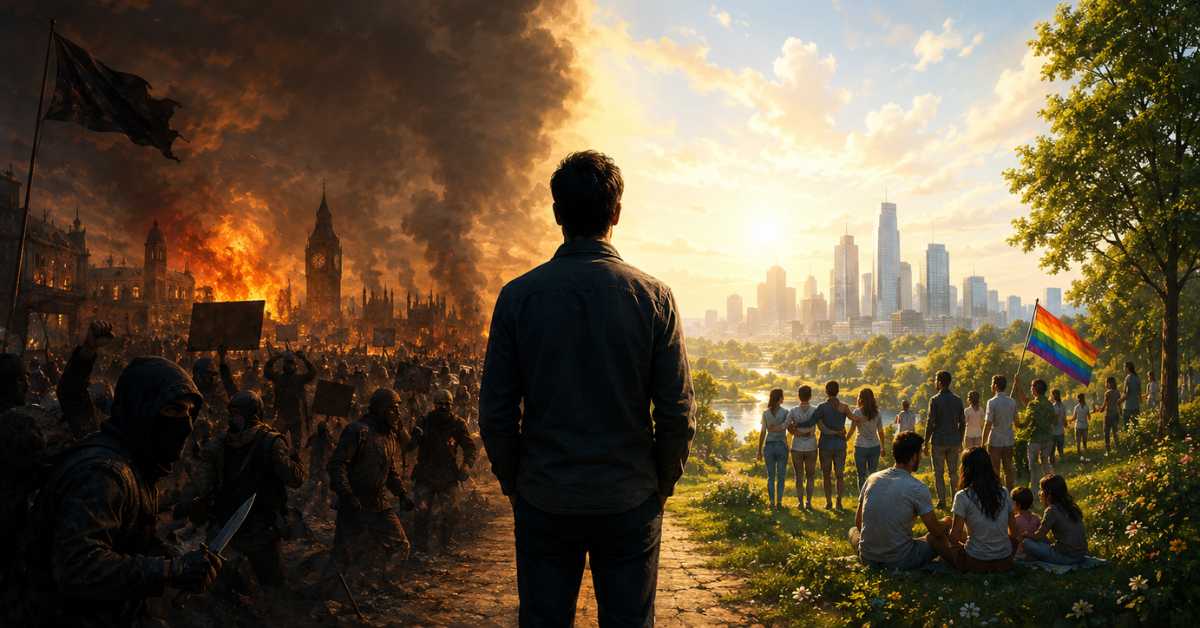
Today we are living in a world of a certain left-wing political correctness, which in some ways is completely sensible, needed, and justified, while in other aspects it has completely gone overboard in the wrong direction—spilling into domains that are outright damaging and dangerous to the general public.
Historically, we started by freeing the slaves, went through the women’s rights movement, sexual revolutions, and now we are addressing systemic racism. We are also addressing historical problems such as issues that arise with past colonialism, geopolitical tensions, environmental concern, and other perceived wrongdoings—both past and present—committed against groups worldwide.
Of course, all of this represents noble pursuits, guided by our desire for complete inclusivity and equality—a utopian premise and vision of the world. This is also why it makes sense to build on this success and push toward even greater equality and inclusivity, righting even more historical wrongs.
However, we must also allow the world to catch up with this idealism, as people need time to adjust to the new challenges that arise with each step of social change. For example, by trying to promote complete equality, we have invited people into our communities who don’t want to assimilate, who don’t want equality, and in fact want to cause us harm. We are screaming, “Everyone is welcome and they are our friends,” while they stab us, as we scream “help!”—while the police arrest us and call us racists, letting the person who caused us harm go free.
I’m of course talking about the case of Henry Nowak, which led to huge riots in Ireland, the UK, and all over the EU and the Western world—a culmination of two-tier policing and politics, backed by countless similar examples of stabbing, raping, crime, and otherwise violent and uncivilized behavior by people who arrive from these less fortunate backgrounds, leading to riots all over the West, while politicians are ignoring and covering up these scandals.
I’m also talking about:
- Grooming gangs are reported to have victimized over 250,000 women in the UK—gangs that were allowed to exist while police and politicians covered them up because they didn’t want to be seen as “racist.”
- The Queers for Palestine movement, where queer people protect those who would kill them at the first opportunity.
- White people who are ashamed of being white due to historical issues like colonialism, as we are now ashamed of what others did in the past.
- Men who are afraid to be men, as they are told the state of the world is their fault.
- Locals who are being forbidden from waving our own country’s flags in our own countries, while terrorist organizations are allowed to wave theirs.
- Unvetted immigrants—some with criminal records—who are welcomed into our countries with free hotels, phones, healthcare, fully paid accommodation, and generous allowances, many of whom receive these benefits for years without ever attempting to assimilate, find a job, learn the local language or customs, or justify their presence—all while locals struggle to afford basic necessities.
- The same immigrants who later kill locals, destroy private property, rape children, and are protected by the legal system, while anyone complaining about these issues is called a racist and thrown into prison.
- Politicians calling for population replacement, treating foreigners better than their own citizens.
\All of the above, by the way, is as current as the news about Henry Nowak, and it is connected to another broader topic: the Islamization of the world.
From Guilt to Action
Personally, as a white straight man, all my life I was told that I’m privileged, that this privilege is built on the backs of other, less fortunate people, and therefore the state of the world today is my fault. In turn, I was told that I should repent and pay for the mistakes of others, especially white straight men who made much of this privilege possible, as I’m told that I’m perpetuating patriarchy, capitalism, racism, and other similar concepts simply for being who I am. And for the longest time, I listened and agreed with this condescension, and it gave me depression.
However, later, as I contemplated how to fix my depression, I questioned whether my repentance was making the world a better place. After all, in many ways, the above-mentioned problems we are having today as a society are a result of Western people being told to repent for being themselves, inviting the less fortunate to dictate how exactly people like me should lead our lives, and in turn leading the whole idealistic movement down the drain as it tries to uplift the less fortunate at the expense of everyone else.
Now, I no longer believe that it is a zero-sum game, as someone else’s well-being doesn’t have to come at the expense of my own. Instead, we can and should try to be the best person we can be and try to create a better world for everyone––which I do via this blog, my coaching, and my books. In fact, we don’t even have to do anything for anyone, as most people won’t do anything for other people, which is completely fine—as long as we are not actively making other people’s lives worse, our collective effort still uplifting everyone, because our success spills over into a better economy and therefore more opportunities for others.
It’s like taxing the rich. They indeed often pay less in taxes, which arguably isn’t fair, but they also create more opportunities and jobs for everyone else. So finding a healthy balance between necessary taxation, regulation, and incentives is still important to help people become their best selves, which ultimately helps everyone else, too.
However, doing the opposite—punishing others, trying to replace people, using violence as a tool to perpetuate more violence, making whole populations feel worse off just because they are privileged, because they allow it, and because you have the power to do so—only leads to more problems.
The Duality of Human Experience
As I said in my previous blog post, everyone is suffering, and if you want, you can always find something to be discontent about with yourself, and with everyone else. For example: men vs. men, men vs. women, women vs. women, children vs. adults, poor vs. rich, white vs. black, husbands vs. wives, and every other permutation.
Of course, you can also find something positive even in something extremely negative. Take killing, for example, which is bad because violence of all types is ultimately bad, and in most cases we don’t like it, as we consider all life to be sacred. However, in some cases, it seems to be justified, such as in self-defense or to end someone’s suffering, especially if they ask for it. Or take hard drugs (e.g., cocaine and heroin), which we know to be very addictive and often destroy people’s lives. The benefit of these is that they provide economic benefits for some people and an amazing high for their users.
In turn, this leads to a never-ending debate as to who is right and wrong, as politicians claim that their views are correct and the other party is wrong, as it is always possible to find something good and bad about every argument, while whole countries go back and forth depending on who screams the loudest.
As such, most people are happy to state the benefits of something they are defending, often completely discarding the negatives—or vice versa, as they just pick one side of the argument, completely unaware of or deliberately discarding the other point of view.
However, as Proverbs 18:17 states, “There are two sides to every story. The first one to speak sounds true until you hear the other side and they set the record straight,” suggesting that, in the best-case scenario, we should be aware of both perspectives and pick what makes more sense. In most cases, we can say if something is working better than something else, as some positive points are superior to the negatives.
And yet, as in most things, there are never absolute truths, and the truth can often be found somewhere in the middle. Even in the case of hard drugs and killing, most people will agree that these things are negative. But while they are, it is also not advisable to completely ban them from our systems, as in certain cases they are justified. For example, because of the hard ban on drugs in the Western world, dark markets emerge to supply the demand. As such, while hard drugs shouldn’t be sold in local pharmacies, it is perhaps advisable that they can still be acquired in some dedicated areas, like special rehab clinics, where people can go legally and risk-free. There would, of course, be some controls over who and when can receive them, but overall, people would be able to get them.
Still, we can end up doing something positive for all the wrong reasons or cause harm in the name of good. For example, I say that, generally speaking, I support left-wing politics, while at the same time I’m completely aware of how the left has completely screwed up regarding certain topics (e.g., immigration), where the right seems to be doing a much better job. This isn’t to say that the right isn’t screwing up in a major way on a completely different set of topics (e.g., abortion—at least that’s my opinion). And so we are left to compromise on what we ultimately prefer more.
At the same time, I often see moral indignation when people try to take the high road when they speak about a subject. However, ultimately, just because you are angry doesn’t mean that you are right, especially if they never explored the opposite point of view and understood it in its totality as good (or better) than the other party that defends the opposite point of view (as there will always be someone who sees benefits in doing something we perceive as wrong).
The Path Forward
In the end, people say, “I didn’t vote for this.” But we did vote for left-wing idealism to end slavery, support women’s rights, sexual revolutions, the fight against racism, and similar movements, all culminating in a vote for equality and inclusivity.
However, we made mistakes along the way, such as inviting the wrong people into our homes—especially those who wanted to harm us, exploit our benevolence and idealism, and make good people feel guilty for their actions.
Our benevolence was used against us, and then we were forced to confront our mistakes. Some people, like me, had to accept that we were wrong, face the respective consequences, and ultimately become even better individuals, as we realize that while we still want the world to be a utopian paradise, but that the road to hell is paved with good intentions.
My overall point is that while a utopia of happiness is still possible, it will still be built around concepts of equality and inclusivity. And we can get there, but we still need to take intermediary steps. Ideally, we need to realize that modern scandals, remigration, making the Western world white again, deportation actions, some high-level figures’ heads having to roll, and similar actions may seem like a step back from our idealized future. However, they are still steps in the right direction. Just because we went in the wrong direction—regardless of how far we went—doesn’t mean we need to continue walking that way. Ultimately, we will be better off because we learned more about what we want and who we are.
The bottom line is that utopia is still possible, and we know more about what we need to do to get there. So while society today is wrong on many levels, including the simple fact that in certain cases, immigrants are bad, but at the same time, local people are bad too, it isn’t as straightforward as we ideally want it to be. Still, if we know what we want to achieve, how we achieve it will become progressively clear.
Ultimately, the best utopia would be built around the topic of the greatest happiness for the greatest number. So if more people progressively feel happier, we are doing something right.
Closing Thoughts
When I first started to write this blog, I was interested in my own sense of happiness because of the aforementioned depression I suffered around the age of 25. Later, as I fixed this part of my life and started to teach others how to achieve similar results, I realized there is a higher calling: to create a society where people are automatically happy.
A new question arose: How can we achieve optimal happiness not only for individuals but for entire societies? What does it take to create a perfect society based on principles of happiness, where people are automatically the happiest without ever needing to learn the lessons about happiness I have accumulated in my professional career?
In turn, this led me to examine modern political issues and consider how to address them, which is where we come back to this blog post. Here, I address topics like the case of Henry Nowak, problems related to modern-day uncontrolled immigration into the Western world, and the role of Islam in all of this.
Overall, I am in the process of writing another book, Optimal Happiness but for society at large (title will be announced shortly), which is coming out soon. So if you like my writing, please follow me for more.
Stay happy!